


Blog
How to Choose the Right Primer for Your Reloading Needs (Small vs Large vs Magnum)


How to Choose the Right Primer for Your Reloading Needs (Small vs Large vs Magnum)
Table of Contents
-
Quick product query — which primer should I use?
-
What is a primer and why does primer selection matter?
-
What’s the difference between small and large primers?
-
When should I choose a magnum primer instead?
-
How do I test primers safely during load development?
-
How should I store and ship primers safely?
-
Where can I buy match or standard primers (examples)?
-
FAQs — quick answers you can reuse on product pages
-
Final checklist — how to choose the right primer for your reloading needs
-
SEO details & meta
1. Quick product query — which primer should I use? how to choose the right primer
If you want to choose the right primer for your loads, start by asking two questions: what cartridge and powder am I using? and does the published load data call for a specific primer type? The correct primer is the one specified by authoritative load data, or the one that gives safe, consistent ignition and the lowest ES/SD in your testing.
2. What is a primer and why does primer selection matter?
A primer is the small, impact‑sensitive component that ignites powder inside a cartridge. Primer selection matters because it affects ignition energy, flame characteristics, consistency, and — in some cases — pressure and point of impact. For precision shooters, choosing the right primer can reduce velocity spread and tighten vertical dispersion; for practical shooters, it mostly ensures reliable ignition.
Key takeaway: to choose the right primer you must treat primers as a component in the load recipe — not a cosmetic afterthought.
(Authoritative primer product pages and SDS confirm manufacturers make and test primers to specific tolerances and storage guidelines.)
3. What’s the difference between small and large primers?
Small vs Large refers only to physical size — small primers fit cartridges with small primer pockets (e.g., .223 Rem), while large primers fit cartridges with bigger primer pockets (e.g., .308, .45 ACP). Both sizes come in standard and magnum power levels, and both may be offered in match variants (manufactured to tighter tolerances).
How to pick between them:
-
Match the brass: the case dictates small vs large — don’t guess.
-
Match the manual: start with the primer recommended by the powder/bullet or the reloading manual.
-
Consider match vs standard: if you’re trying to shave ES/SD and vertical dispersion, test a match primer (e.g., Federal Gold Medal or Winchester USA Ready match primers).
Example internal links you can use on your site:
-
Browse match primers: https://primereloaders.com/category/primers (category page)
-
Federal 150M (match small pistol): https://primereloaders.com/product/federal-150m
-
CCI large pistol (standard): https://primereloaders.com/product/cci-300
4. When should I choose a magnum primer instead? small primer vs large primer
What is a magnum primer?
A magnum primer delivers a hotter / longer burning flash to help ignite powders that are harder to light (large case volumes, certain slow powders, or heavy charges).
Ask yourself:
-
Does published load data call for a magnum primer (e.g., #155/#350 for pistols, some rifle recipes)? If yes → use magnum.
-
Do you have large case volume or a slow, hard‑to‑ignite powder? Magnum primers can improve ignition consistency there.
-
Are you substituting a magnum for a standard primer? Only do this by test — magnum primers can change pressure and POI.
-
Practical rule: don’t substitute magnum primers into a recipe that doesn’t call for them unless you test from published minimums and watch for pressure signs.
5. How do I test primers safely during load development?
How do I test to choose the right primer? — Use a controlled, repeatable test procedure:
-
Pick one variable at a time. Change only the primer; keep brass lot, powder charge, seating depth, and bullets identical.
-
Start low and follow published data. Always begin at the published minimum if trying a different primer.
-
Chronograph every string. Record velocity, ES/SD, and temperature — look for lower SD and smaller extreme spread.
-
Check for pressure signs. Flattened primers, sticky extraction, or primer flow are warning signs — stop immediately if you see these.
-
Document everything. Lot numbers, primer SKU, brass brand and lot, primer seating depth, and chrono results. This documentation helps you reproduce results.
-
If your goal is to choose the right primer for match work, expect marginal gains — the primer is one of many small variables that add up.
6. How should I store and ship primers safely?
Storage & handling basics (manufacturer SDS guidance summarized):
-
Store in original packaging in a cool, dry, ventilated location. Keep away from acids, strong oxidizers, and sources of heat.
-
Don’t crush, strike, or expose primers to friction or flame. Use purpose-built priming tools.
-
Secure primers (locked storage) and treat shipments as HAZMAT where carriers require adult signature and special handling.
-
Quick safety checklist to post on product pages: include manufacturer SDS link, storage bullet points, and a photo of trays/boxes with alt text (below).
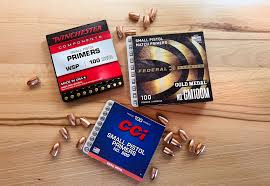
7. Wh
ere can I buy match or standard primers (examples)?
If you want to choose the right primer from trusted brands, consider:
-
Federal Gold Medal (150M/210M) — match-grade variants for pistols and rifles.
-
Winchester USA Ready (match line) — match tolerance primers used in Winchester’s match ammo.
-
CCI (300, 350) — trusted core line for dependable ignition and popular pack sizes.
Internal product links examples you can paste into your post:
-
Federal match primers:
https://primereloaders.com/product/federal-150m -
Winchester match primers:
https://primereloaders.com/product/winchester-usa-ready -
CCI primers (bulk):
https://primereloaders.com/product/cci-300
8. FAQs — short copy‑ready answers (good for FAQ schema)
Q: Will a match primer always reduce group size?
A: No — match primers can help reduce ES/SD and vertical dispersion in well‑developed loads, but many shooters will not see a measurable difference in casual loads. Testing is the only reliable way to know.
Q: What’s the difference between 150 and 150M or 155 and 155M?
A: The “M” indicates a match variant manufactured to tighter tolerances. 155M is a magnum match primer (magnum ignition with match consistency).
Q: Can I substitute magnum primers for standard primers?
A: Only after testing — magnum primers can change ignition intensity and pressure. Start at published minimums and check for pressure signs.
Q: How long do primers last in storage?
A: Properly stored primers remain serviceable for many years — keep them in original sealed trays/boxes and inspect before use.
9. Final checklist — how to choose the right primer for your reloading needs
-
Read the load manual first — use the recommended primer type.
-
Match primer size to your brass (small vs large).
-
Use magnum primers only when specified or when test data supports them.
-
Test with a chronograph and one variable at a time.
-
Store primers per SDS: original packaging, cool/dry, locked.
-
If buying match primers, keep lot numbers and buy enough for your test session to avoid mid-test lot changes.
-
When ready to buy: check primer categories and these product pages on primereloaders.com.
If you follow that checklist you’ll reliably choose the right primer for both safety and performance.